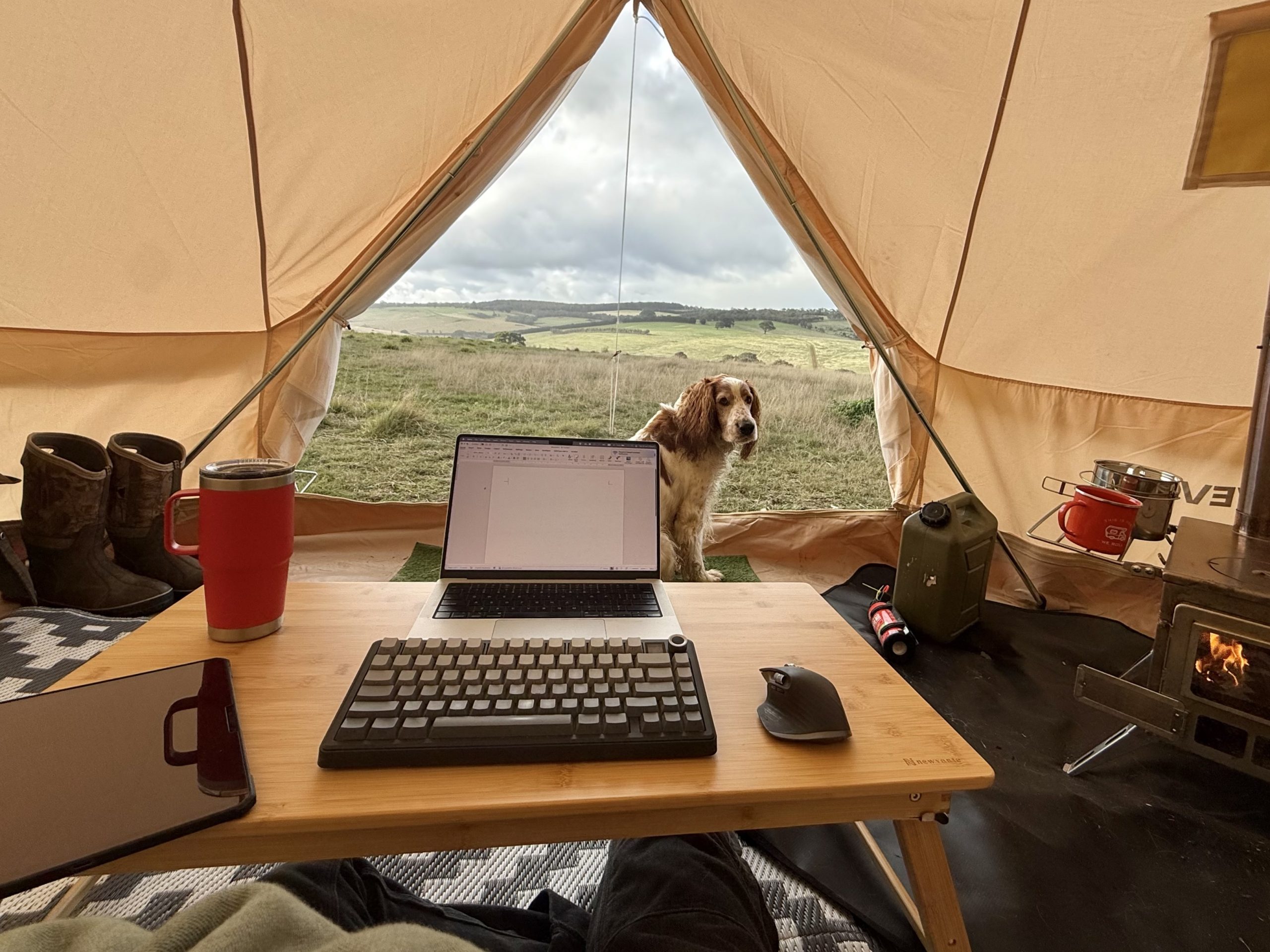
Saturday musings from the tent. Writing has looked rather different recently. ✍ ⛺
I’ve been working in a tent on my farm in recent weeks. The canvas doors open out towards the paddocks. Throughout the day, I watch the clouds move and the sky shift through a range of hues until it turns dark – with a blanket of stars faintly illuminating the night sky.
The winter chill can be intense. Between paragraphs, I feed the fire in the small wood stove beside me. Working from here, I feel a different proximity to land.
It’s not a productivity hack, but there is something about the discomfort, slowness and friction of a working space that, quite ironically, generates ideas and writing that feel far more productive and creative than sitting in a heated office with all the ergonomics, perfect lighting and proper infrastructure.
The past couple of weeks have been full, but in a quieter way. Between semesters, I’ve had a small opening to return to the work that often gets pushed to the edges – writing, creative practice, and thinking without the noise.
Writing takes up a lot of mental space before it becomes anything visibly complete. I spend far too long moving one sentence around, deleting it, putting it back – and then realising the problem was never the sentence, but perhaps the cluttered thoughts underneath it.
I recently become less interested in the idea that all forms of academic pressure can be solved by blocking out time, better email hygiene or better self-management. I find that to be a convenient way of re-framing structural issues as personal failure.
Academic work depends on attention, but academic life does not always protect it. We ask people to produce research, original thinking, good teaching, meaningful leadership, grant applications, reports, curriculum work etc, slicing up the working day itself into smaller and smaller pieces.
Emails. Meetings. Deadlines. More meetings. False urgencies. Inside all that – between meetings and emails – the work of thinking is expected to happen quietly. The longer I am in academia (over 20 years now), the less I am convinced that meaningful work can keep surviving on leftover attention.
Perhaps this is why writers have always been somewhat obsessed with where writing happens. There is Thoreau’s cabin by Walden Pond. There is Virginia Woolf’s room. The workspace is not merely a backdrop – it shapes attention.
My tent is not quite a room though – there’s a softness to it. Canvas instead of walls. A threshold rather than a sealed interior. I’m not looking through a window – I’m just there. You feel the weather. The cold gets in and the fire needs tending.
It’s not perfect – but it gives me proximity to land – and a different condition of attention.
Somehow, I’ve been more productive than ever.