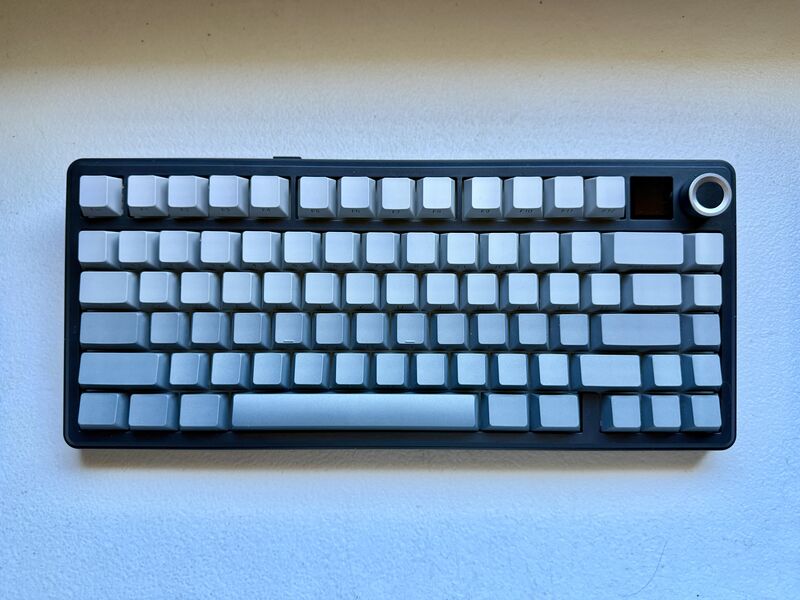
I got a new keyboard. Small acquisition – but it brought me a disproportionate amount of joy and happiness.
I care a lot about keyboards – not as accessories – instruments. It is the mediator between the thinking and the screen. I treat my keyboards like a wardrobe, different keyboards for different occasions and different kinds of work, different mood and cognitive states. Drafting a research abstract, writing a business case – or even writing an e-mail to reschedule a meeting, a good keyboard gives solid tactility, auditory feedback – a sense of confirmation and conviction. You’ve enacted something and concluded something. It adds cumulative joy to my work.
This keyboard is entirely grayscale. 75% layout. Its keycaps carries no printed legends, just a faint reference on the front edges. Most of us are touch typists anyway – legends are redundant. I am no minimalist, but I’m not certain why we still need letters printed on keyboards. The subtle notches on letters F and J allows us to physically anchor our hands without any visual distraction. In the same context as UX and UI – the unnecessary accumulation of labels and prompts in the name of reducing user friction, inadvertently adding visual + cognitive clutter to the experience.
We tend not to think much about keyboards, despite how significant the cumulative hours of our professional life is spent on them; and how much of serious (or unserious) work is churned out. Mechanical keyboards have a lifespan of 50-100 million keystrokes. Membrane keyboards (eg on your laptops) last a mere 5 million keystrokes. There’s nothing extraordinary about keyboards – they are very ordinary objects subjected to extraordinary repetition. Repetition compounds – redundancy, clutter, friction, all that jazz. This logic goes well beyond keyboards.
Of late I’m starting to observe how we often underestimate cumulative effects of habitual decisions and actions – however small and mundane, that sit beneath everyday work and personal lives. Tools we use a thousand times a day are not neutral – like this keyboard – it shapes posture, attention, thinking, (and in my case joy) in small but significant ways that quietly compound over time.
It’s not about keyboards – it’s how we design systems, make simple decisions and act on matters – for longevity rather than current trends. For small progress and momentum, rather than one huge win. Removing unnecessary complexity, friction, clutter, redundancy – little daily annoyances that we tolerate out of habit, but cumulatively, collectively – these little changes reshape how people think, learn and act for an infinite amount of time. I’ve become more intentional about noticing small frictions – and ones worth fixing.
I find myself increasingly interested in design and leadership that knows when to stop.
(PS: This keyboard is not loud enough. I like my keyboards obnoxiously loud. Will be swapping out the switches.)