The long weekend gave me a short gap between busy university work to continue working on The Wind Writes project, which explores wind as an interaction agent within a more-than-human interaction design system.
Over the past 5 days I’ve been out at the farm installing the weather station – pulling everything together and getting the system working with live data. I have a fair bit of travel in forthcoming weeks, I needed to set it up now and make sure it all works, so I could continue building the system off live data whilst I’m away.
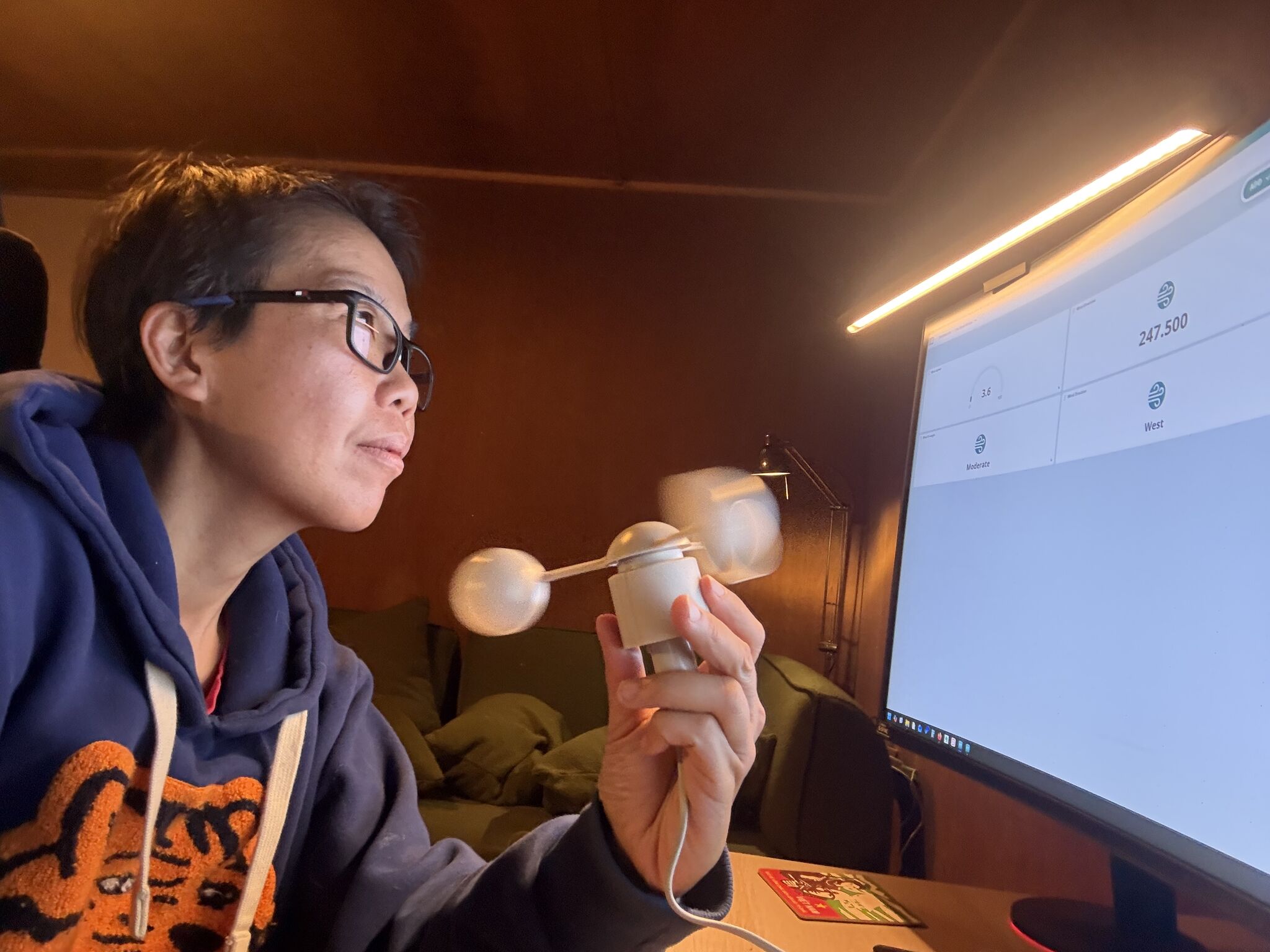
Installation of the weather station took 10 minutes, but getting the live data calibrated to precision was tedious. The wind vane (direction) and anemometer (speed) are connected via RJ11 into the ESP32 board, which sends data up to Arduino Cloud – from the cloud my system pulls live wind data and generates texts and typographic behavior in response to wind conditions off my farm.
It’s a technical daisy-chain but a clear shift – the system is no longer running on simulated inputs that I could manually adjust. It’s now fully dependent on conditions outside.
I’ve been moving between the shed and paddocks while setting this up, watching data come through and making adjustments. Then stepping back outside again to check what the wind is actually doing that precise moment. Because it’s site-specific, the numbers stop being abstract like when you pull weather APIs offsite, instead it starts corresponding directly with what you literally feel on your skin.
The issue here isn’t about having no wind. It’s having too much wind. It’s exactly why we have a wind farm out here. In the exact same spot where I’ve installed this setup – I used to have a wooden weather vane shaped like a Galah bird with its wings stretched out. It was solid – I thought it would last indefinitely, until a gusty day happened and snapped both its wings clean off. This little weather station kit looks filmsy for what I paid for – I’ll be livid if it tears itself apart.
Yet exposure to the elements is what this system now has to operate within – for it’s no longer insulated in a controlled indoor environment. It is subject to the elements – force, unpredictability, volatility. The interface inherits these conditions, it is no longer responding to a user – it is responding to land.
Which makes it challenging – I’m working with behaviour that resists optimisation (and I have to resist optimising it). It raises questions about what interaction design looks like when the system does not prioritise the user.
More work to do – with more emphasis on the system’s response to wind behavior.
Pictures of work-in-progress, getting live data to work on-site with local non-human farm residents – and my Galah weather wane (RIP).
Early thinking behind this project.