<< Back to Research and Projects
The Road to Safer Walking
The Road to Safer Walking is a collaborative research project focused on improving pedestrian safety for older adults through the design and development of an interactive 3D online training platform. The project brings together researchers from RMIT University and Australian Catholic University and is funded by the Australian Automobile Association (AAA).
The project team includes Professor Jonathan Duckworth and Associate Professor Li Ping Thong from RMIT, working alongside Dr Joanne Bennett and Dr Thomas McGuckian from Australian Catholic University (ACU). The project focuses on developing innovative approaches to address the growing issue of pedestrian injuries and fatalities among Australia’s ageing population.
As Australia’s population ages, older pedestrians face increased risk in road environments due to a combination of physical, sensory and cognitive changes. Traditional road safety education methods often fail to account for these changes. This project explores how games, interaction design and accessible user interfaces can support older adults in strengthening hazard perception skills and responding more effectively to traffic-related risks.
Project Focus
The central outcome of the project is the development of a 3D simulated online training platform designed specifically for adults aged 60 and over. The platform integrates immersive 3D simulations with gamified learning elements, allowing participants to experience pedestrian scenarios in a safe, controlled environment. Through repeated exposure to simulated road environments, users are able to practice identifying hazards and making safer walking decisions.
The system is designed with a strong emphasis on accessibility and inclusive interaction design. Because the target audience includes users with varying levels of digital literacy, as well as potential sensory or cognitive impairments, the platform prioritises clear navigation, readable interface design and interaction models that minimise frustration and cognitive load.
Alongside simulation-based training, the program also incorporates elements that engage physical and cognitive skills relevant to pedestrian safety. This integrated approach allows participants to develop practical awareness and behavioural responses to real-world traffic environments.
Design and User Research
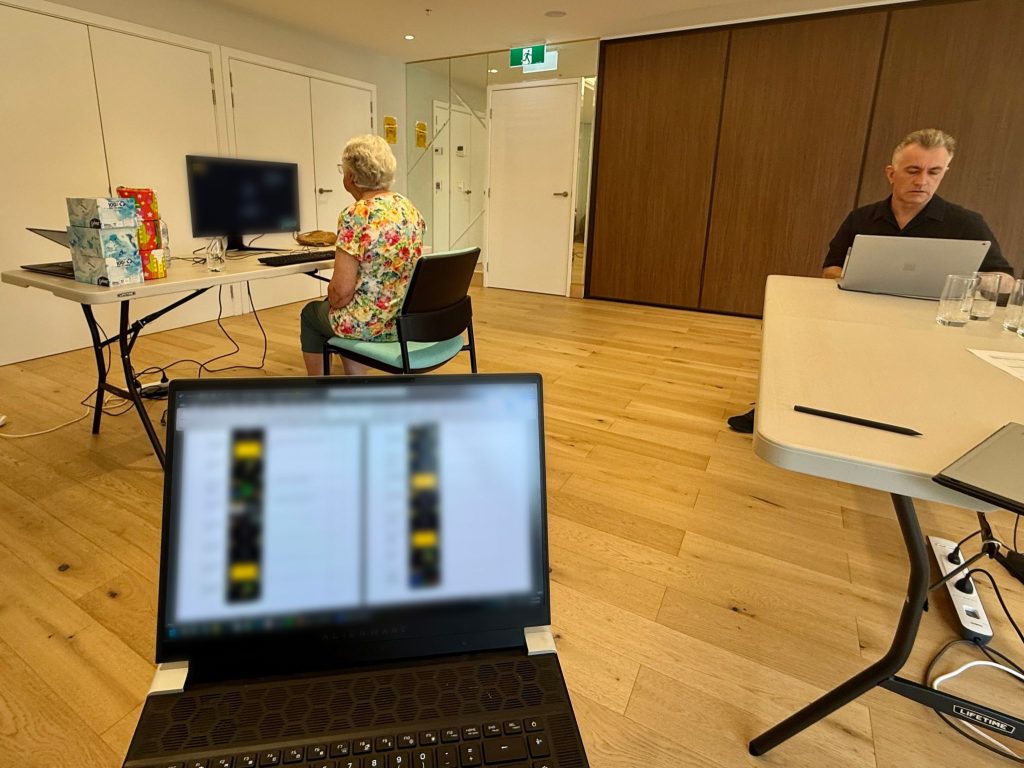
A key component of the research involved usability testing with older adults, including participants aged between 70 and over 80. These sessions provided critical insights into how ageing affects interaction with digital systems.
Observing real users interacting with the prototype revealed subtle but important design considerations that are often overlooked when designing for assumed user personas. For example, the optimal viewing angle of monitors was influenced by the use of bifocal lenses, while mouse control precision and the presentation of on-screen instructions required adjustment to reduce friction in the interaction process.
These findings reinforced the importance of designing with real users rather than relying solely on theoretical models of accessibility. Inclusive design requires careful attention to the lived realities of users, particularly when working with populations whose physical and cognitive capacities may differ significantly from younger cohorts.
Research Significance
The Road to Safer Walking project represents one of the first initiatives in Australia to utilise gamified learning to address pedestrian safety for older adults. By leveraging digital design methodologies and rigorous user testing, the project contributes to a new model of road safety education that is experiential, accessible and responsive to the needs of ageing populations in Australia.
More broadly, the project demonstrates the role digital design can play in addressing complex societal challenges. Through interdisciplinary collaboration and partnership with industry stakeholders, the research explores how emerging technologies can support public safety outcomes while maintaining dignity, usability and independence for older users.
Project Team
Dr Joanne Bennette (Australia Catholic University)
Dr Thomas McGuckian (Australia Catholic University)
Professor Jonathan Duckworth (School of Design, RMIT University)
Associate Professor Li Ping Thong (School of Design, RMIT University)
Professor David Greene (Australia Catholic University)
Professor Peter Wilson (Australia Catholic University)
Dr Michael Psarakis (Australia Catholic University)
Dr Andrew McKinnon (Australia Catholic University)
Funding / Support
Australian Automobile Association (AAA)